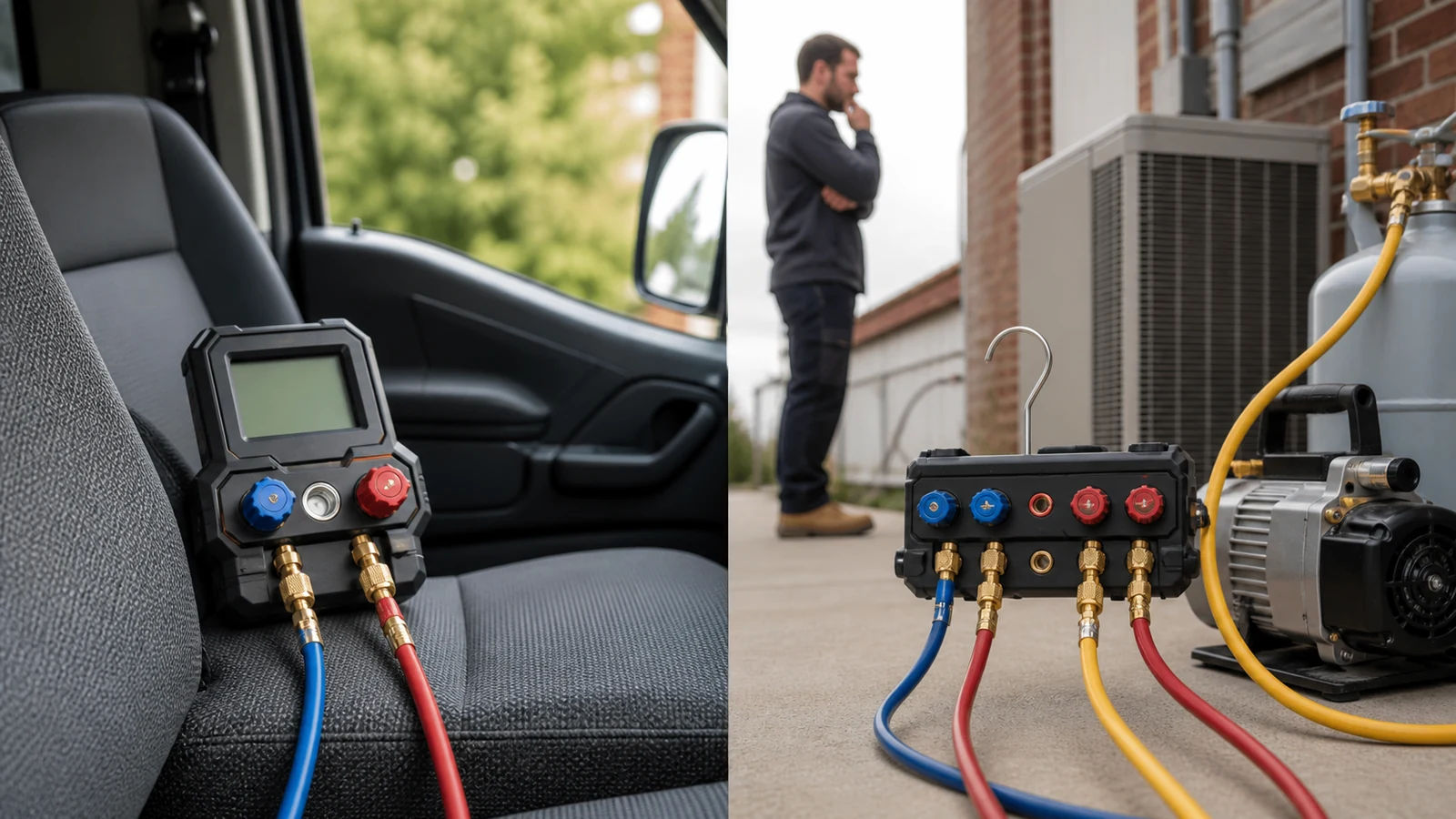
When Is A 2 Valve Digital Manifold Enough Uk
Direct answer: a 2-valve digital manifold is usually enough for high/low pressure diagnosis, many service charging tasks and technicians upgrading from familiar analogue two-valve habits. A 4-valve setup starts to earn its keep when you repeatedly need vacuum, recovery and charging paths connected with fewer hose changes.
Valve count is a workflow decision. The better question is what your last ten jobs actually required, not whether four valves sound more professional.
Decision table
| Job pattern | 2-valve digital fit | When four valves look better |
|---|---|---|
| Reactive diagnosis and pressure checks | Strong fit. You keep the familiar high/low valve layout and gain clearer digital readings. | Only if your call-outs often turn into full evacuation and recharge workflows. |
| Routine service charging | Often sufficient when your procedure is simple and hose changes are acceptable. | Useful when simultaneous paths reduce repeated set-up time. |
| Install and commissioning days | Can work for limited tasks, but check the full procedure first. | Stronger where vacuum, recovery and charging equipment are staged together. |
| Team standardisation | Good when apprentices and experienced techs need a simple shared sequence. | Better if the team SOP is already built around four-valve manifolds. |
What the trade sources say
This 2-valve and 4-valve manifold workflow explainer frames two-valve manifolds around routine high/low service diagnosis and four-valve blocks around reducing hose changes for vacuum and recovery/charge work. That matches how many UK technicians experience the choice: less about status, more about day shape.
Two-valve is still a mainstream category, not a beginner-only compromise. Javac's UK product line includes an R410A/R32 2-valve manifold line, while the SRW manifold gauge buying guide discusses digital manifold benefits in the wider context of modern heat-pump and inverter work.
Map the last ten jobs
Count how many jobs were diagnosis-only, how many involved a simple charge, and how many required full pull-down, recovery, vacuum and recharge staging. If seven or eight were diagnosis or routine service, a two-valve digital manifold is defensible. If half your week is installation and commissioning, four valves may save time and handling.
Who should not rely on two valves alone
Do not buy a two-valve instrument as your only kit if your SOP demands simultaneous vacuum and charge paths, if you need logged superheat/subcooling reports with clamp inputs, or if your employer has standardised on four-valve equipment. In those cases, a simpler unit may become the awkward exception in the van.
Conditional next step
If your work is mostly service diagnosis, you want a familiar two-valve layout and you have separately confirmed hose/fitting compatibility, compare a same-site option such as the DMG-2SE product page. If your work pattern is install-heavy, shortlist four-valve kits before buying.