Air Conditioning Pressure Gauge Readings: A UK Guide
Air conditioning pressure gauge readings are two numbers — suction (low side) and head (high side) pressure — and on their own they mean very little. Their value appears when you convert each to a saturation temperature for the refrigerant in the system and compare the result against the conditions the machine is working in. This guide is about that interpretation: what normal looks like on UK systems, what the common abnormal patterns mean, and when the reading itself is lying to you.
Key Takeaways
- Pressures only mean something as saturation temperatures: suction pressure maps to the evaporating temperature, head pressure to the condensing temperature.
- Reference ranges are sanity checks, not targets — the manufacturer's charging chart for the exact unit and ambient is always the number that counts.
- Patterns diagnose faster than single values: both-low, high-head and quick-equalisation each point somewhere different.
- Superheat and subcooling are the confirming numbers; charging by pressure alone is the classic route to a call-back.
The two numbers you are actually reading
The low-side (blue) reading is the pressure of vapour returning to the compressor. Convert it for the refrigerant in use and you get the evaporating temperature — how cold the indoor coil is running. The high-side (red) reading is the pressure after compression; converted, it is the condensing temperature — how hard the system is working to reject heat outdoors.
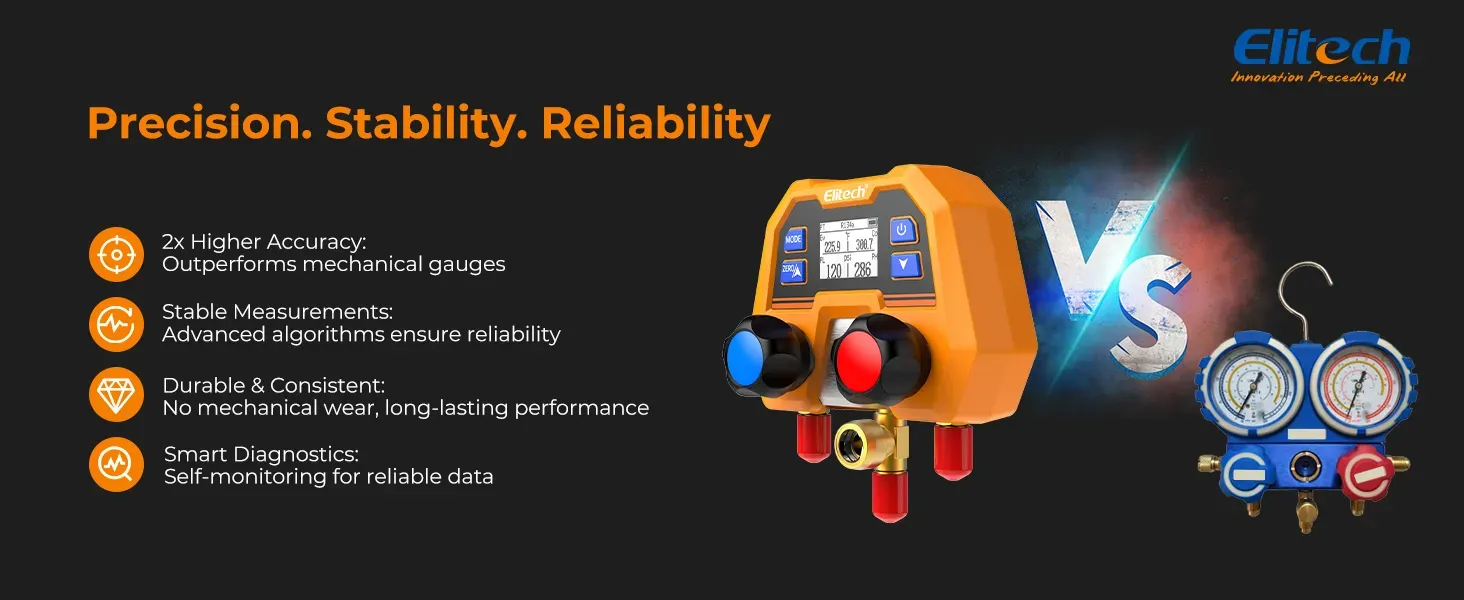
That conversion step is where analogue and digital workflows part company. On a multi-ring analogue dial you read the needle, find the right refrigerant ring or a paper PT chart, and interpolate. A digital manifold shows pressure and saturation temperature side by side for the profile you selected — one glance instead of a lookup, which matters at the top of a ladder in the rain.
What normal looks like on a UK split system
For a healthy R32 split or heat pump in cooling mode on a warm UK day, typical running figures fall roughly here:
- Suction pressure: around 7–10 bar (roughly 100–150 PSI), corresponding to an evaporating temperature of about 0–10 °C.
- Head pressure: around 24–31 bar (roughly 350–450 PSI), corresponding to a condensing temperature of about 40–50 °C — typically 10–15 K above the outdoor ambient.
Treat those as sanity-check bands, not pass marks. Line length, indoor load, airflow and outdoor temperature all move the numbers, and every manufacturer publishes charging data for the specific model. R410A systems run in broadly similar territory — close enough that you cannot identify the refrigerant by gauge feel, which is exactly why selecting the correct profile (or reading the correct dial ring) comes before believing any figure.
Static readings: the check before the compressor runs
With the system off and pressures equalised, both sides should settle at the saturation pressure for the ambient temperature. That single static reading is a quietly useful test: if the equalised pressure matches the PT value for the refrigerant on the nameplate at today's temperature, the charge is at least plausible and the gauge profile is right. If it sits far below, you are likely short of refrigerant before the compressor ever starts.
Reading patterns and what they usually mean
Both pressures low
The classic signature of refrigerant loss, though a restriction upstream of the evaporator can mimic it. Confirm airflow, then treat it as a leak until proven otherwise — our refrigerant leak detector guide covers finding the escape point rather than just topping up past it.
High head pressure
Heat is not leaving the condenser: dirty coil, blocked fins, failed fan — or overcharge. Check the simple causes before touching the charge, and never vent refrigerant to "fix" a high reading; recover properly.
Low suction, normal head
Points at the evaporator side: poor indoor airflow, a filthy filter, or a metering device underfeeding. The refrigerant quantity is often fine.
Pressures equalise unusually fast at shutdown
Suggests internal leakage — a compressor valve not holding — or a significant refrigerant circuit fault. Follow up with a standing pressure test.
When the reading itself is wrong
Three failure modes produce confident-looking nonsense. First, analogue needle flutter: on a pulsing circuit the needle swings with every compressor stroke and you end up estimating between graduations — add parallax from reading the dial at an angle and two engineers will log two different numbers. Second, the wrong refrigerant profile or dial ring: the pressure is real but every temperature you derive from it is fiction. Third, connection losses — a half-depressed schrader core or a leaking hose seal reads low at the block, not in the system.
This is the practical case for a digital manifold on mixed workloads: a transducer averages pulsation into a stable figure at 0.1 PSI resolution, the profile is selected by name rather than by ring, and the backlit screen reads the same from any angle in a dark plant room. The Elitech DMG-2SE+ digital manifold gauge set holds 88 refrigerant profiles including R32, R410A and R1234yf and displays pressure with saturation temperature side by side.
Superheat and subcooling: the confirming numbers
Pressure patterns narrow the diagnosis; superheat and subcooling confirm it. Superheat (suction line temperature minus evaporating temperature) tells you how the evaporator is fed; subcooling (condensing temperature minus liquid line temperature) tells you how the condenser is performing. Targets are set by the machine and its metering device, so use the commissioning sheet rather than folklore values. The measurement routine — where to clamp, when to record — is covered step by step in how to use a manifold gauge.
If your decision is about the instrument rather than the interpretation, our digital manifold gauge guide covers the analogue-to-digital upgrade question in full.
Frequently asked questions
What should my gauges read with the system switched off?
After equalisation, both sides should sit at the saturation pressure for the ambient temperature — for example, an R32 system in a 20 °C plant room should stand at roughly 13–14 bar. Much lower usually means undercharge.
Are R32 and R410A readings the same?
They are broadly similar — similar enough to be dangerous, because a plausible number on the wrong profile still gives wrong saturation temperatures. Always set the profile to the refrigerant on the nameplate.
Can I charge a system by pressure readings alone?
No. Charge by weight to the nameplate figure, then verify with superheat or subcooling against the manufacturer's data. Pressure alone does not measure charge quantity.
Why do my readings bounce around?
Compressor pulsation, hunting metering devices and changing load all move pressures. An analogue needle amplifies the visual noise; a digital display resolves it into a steadier figure you can actually log.
Tired of translating pressures by hand?
The Elitech DMG-2SE+ digital manifold gauge set supports 88 refrigerants, IP54 protection and free next-day UK delivery.
View Elitech DMG-2SE+ — £128.9930-day returns · 12-month UK warranty · Secure checkout