Digital Manifold Gauge UK: Upgrading from Analogue Sets
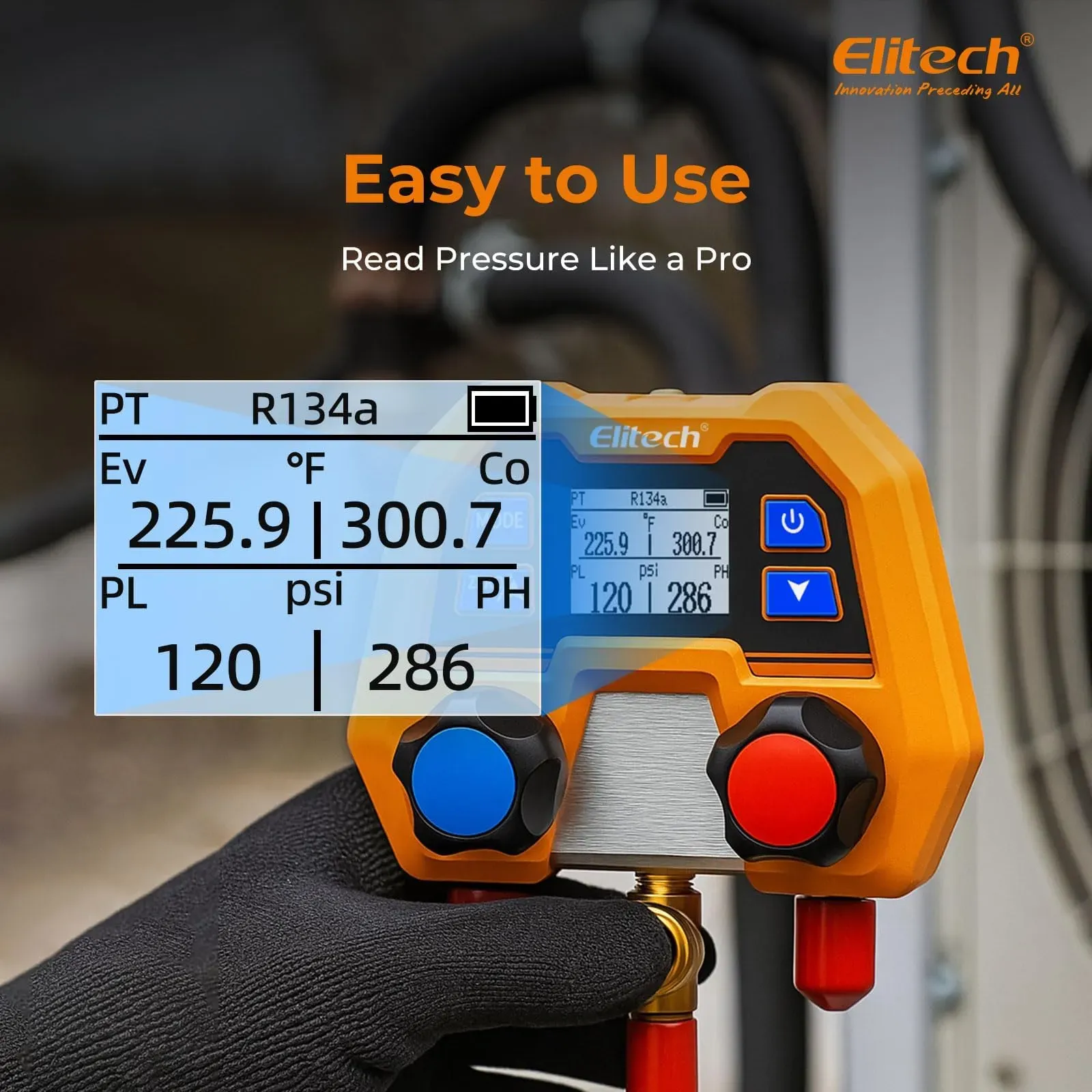
A digital manifold gauge replaces the needles and paper PT charts of an analogue set with pressure transducers, a built-in refrigerant library and a screen that shows pressure and saturation temperature side by side. For UK engineers who already run a two-valve analogue manifold every day, the real question is not what it is, but whether the upgrade earns its keep — and what to check before spending money.
This guide is written for the engineer who trusts a brass block that has never let them down, but is tired of translating pressures by torchlight between a cold rooftop and a packed van.
Key Takeaways
- A digital manifold gauge reads pressure electronically and converts it to saturation temperature on screen, so you stop cross-referencing a PT chart on every refrigerant change.
- The practical wins are repeatability and readability: no parallax, no needle flutter, and figures you can defend on a commissioning record.
- Check five things before buying: stated accuracy (% FS), refrigerant library, pressure range, ingress protection and hose compatibility.
- Honest limits: deep vacuum work still belongs to a dedicated micron gauge, and a backup analogue set in the van remains good practice.
What does a digital manifold gauge do differently?
Mechanically, nothing changes at the block: you still have a low side, a high side and hand wheels. The difference is in how the reading reaches you. Instead of a Bourdon tube driving a needle across a crowded multi-ring dial, an electronic transducer measures the pressure and the gauge looks up the saturation temperature for the refrigerant you have selected — live, on a backlit display.
That single change removes the two slowest steps of analogue work: reading a moving needle to the nearest graduation, and converting that number against a pressure–temperature chart before it means anything. If you service R32 splits in the morning and an R404A cold room after lunch, you scroll to the right profile rather than hunting the right scale ring or the right laminated card.
The problems it solves on a real service day
- Needle flutter and parallax. On a running system, a needle that pulses with every compressor stroke leaves you estimating between graduations. A transducer averages that pulsation into a stable figure with 0.1 PSI / 0.01 bar resolution.
- PT chart round-trips. Every refrigerant change on an analogue set means finding the right chart and hoping you read the right column. A refrigerant library — 88 profiles on the Elitech DMG-2SE+ digital manifold gauge set, including R32, R1234yf, R410A and R744 — does the conversion for you.
- Dark plant rooms and dusk call-outs. If you have ever balanced a torch between your teeth to read a dial in a dim plant room, the backlit LCD is the feature you will notice first.
- Defensible records. A photographed digital readout with the refrigerant profile visible is far easier to stand behind than a needle position recalled from memory.
Digital vs analogue: an honest comparison
Analogue manifolds still deserve respect. They need no batteries, they shrug off being dropped, and for a single-refrigerant round — say, a week of nothing but R410A splits — a well-kept analogue set with a fresh chart is perfectly workmanlike.
Digital earns its price where your workload is mixed and your margins for error are thin: marginal charge diagnosis, heat pump commissioning where the paperwork matters, and any day that has you switching refrigerants between jobs. The reading is clearer, the conversion is automatic, and the accuracy is stated rather than assumed.
Two things do not change with the upgrade, and that is the point: a two-valve digital manifold keeps the exact hose-and-wheel routine you already know, and standard 1/4" SAE fittings mean your existing hoses and vacuum pump connect as before.
What to check before you buy
- Stated accuracy. Look for a factory-calibrated figure — the DMG-2SE+ is calibrated to ±0.5% FS — rather than vague claims of precision.
- Refrigerant library. Confirm the gases you actually service are in the list. For refrigerant-specific buying advice see our R32 refrigerant gauge and R1234yf manifold gauge guides.
- Pressure range. A span of -14.5 to 800 PSI covers vacuum-side checks through to modern high-pressure refrigerants.
- Ingress protection. IP54 keeps dust and splashes out on site work; it is not submersion-proof, and it does not need to be.
- Units and display. PSI, bar, kPa, MPa and kg/cm² switching saves mental arithmetic when paperwork and equipment disagree.
- Power. Three AAA cells running to roughly 140 hours of continuous use means spares live in the glovebox, not in a charger.
Sensor drift and calibration: the fair objection
The most common reason experienced engineers hold off is trust: a mechanical gauge fails visibly, while an electronic sensor could drift quietly. It is a fair concern, and the honest answer has two parts. First, a quality unit ships factory-calibrated with a certificate of conformity, so you start from a known baseline. Second, for F-Gas compliance records an annual UK traceable calibration is recommended — the same discipline you would apply to any instrument your paperwork depends on.
One boundary worth stating plainly: a digital manifold will show negative pressure, but proving a deep vacuum before recharge is micron-gauge territory. Keep a dedicated vacuum gauge for that job.
Where a digital manifold gauge is not the answer
If your work is genuinely single-refrigerant and your current set is accurate and recently checked, the time savings shrink and the upgrade can wait. If what you actually need is guidance on connection and measurement routine, start with how to use a manifold gauge — technique matters more than the tool. And when a reading looks odd, interpretation is its own skill: our guide to air conditioning pressure gauge readings covers what normal looks like and what the common patterns mean.
Frequently asked questions
Do digital manifold gauges drift out of accuracy?
Any measuring instrument can drift. The difference is that a digital unit states its accuracy (±0.5% FS on the DMG-2SE+) and starts from a factory calibration you can verify, with annual UK traceable calibration recommended where readings feed compliance records.
Can I keep using my existing hoses?
If they terminate in standard 1/4" SAE fittings, yes — though the DMG-2SE+ ships with three 1.5 m hoses, so you also have a fresh set matched to the block.
Is a two-valve digital manifold enough, or should I buy four-valve?
Two valves cover everyday service and diagnosis, and keep the routine you already know. A four-valve block earns its extra cost mainly on frequent evacuation-heavy installation work with a dedicated vacuum line.
Do I still need a PT chart at all?
Keep one in the van as a sanity check and a backup. The daily lookup work, though, is exactly what the refrigerant library exists to remove.
\u200bCan you use an HVAC mannequinfor A2L quiet We need clean html only.
Ready to retire the PT chart?
The Elitech DMG-2SE+ digital manifold gauge set supports 88 refrigerants, IP54 protection and free next-day UK delivery.
View Elitech DMG-2SE+ — £128.9930-day returns · 12-month UK warranty · Secure checkout